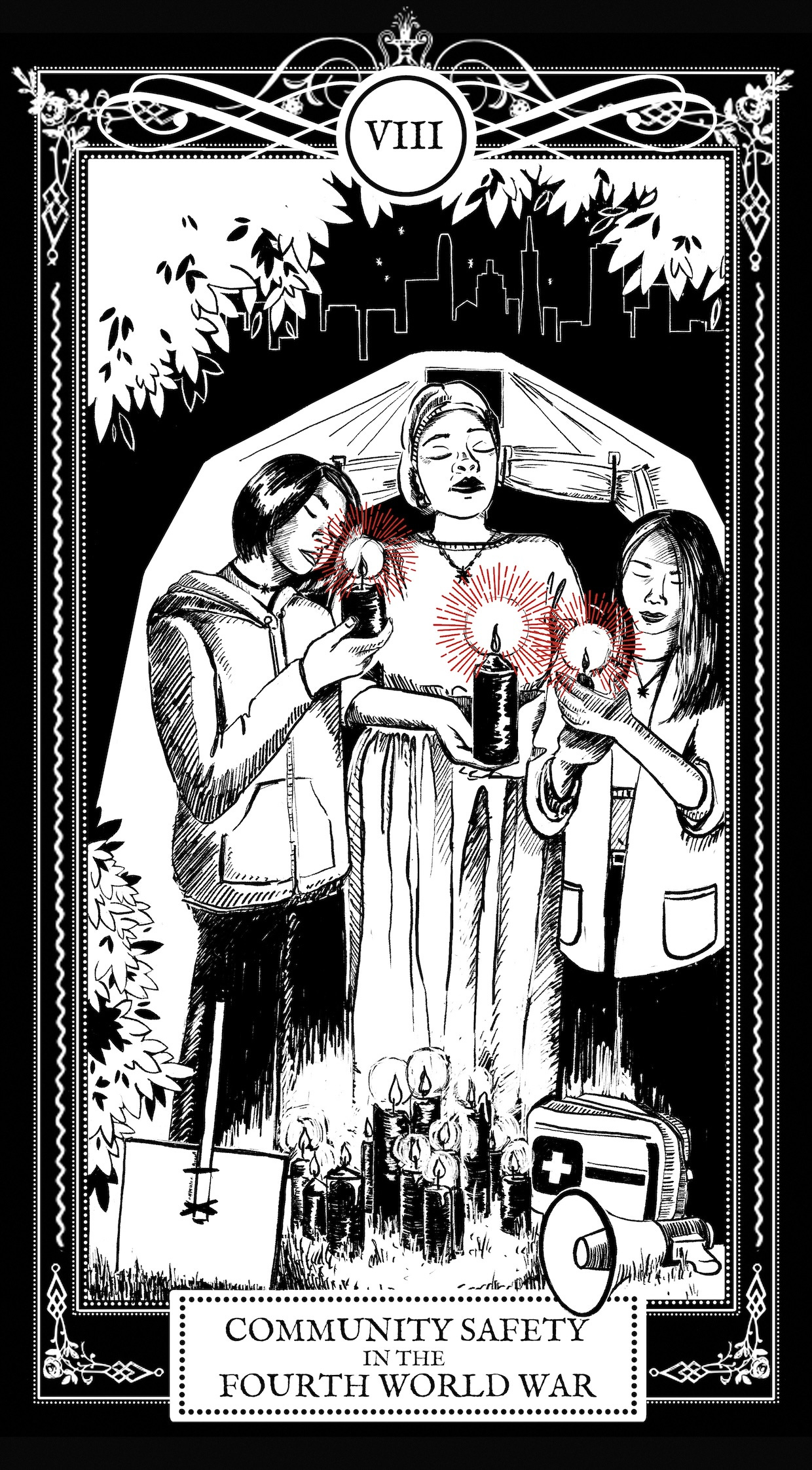
"We're a Winner," A foreword to Community Safety in the Fourth World War
by Stefano Harney and Fred Moten
What does it mean to be a radical “public intellectuals” today, in our age where their violence seems so often to overwhelm our ability to think?
Celebrated critical theorists Stefano Harney and Fred Moten, coauthors of The Undercommons and All Incomplete, consider this question in their loving forward to Manuel Callahan and Annie Paradise’s book Community Safety in the Fourth World War: Notes on Insurgent Conviviality, the eighth book in the VAGABONDS series, edited by Max Haiven, out this month from Pluto Press.

The book draws on more than a decade of “convivial research” and “insurgent learning” undertaken alongside struggles against police and systemic violence and, below, Stefano and Fred contextualize the book’s in terms of the “turn and return” of the question of the committed, activist, insurgent intellectual.
For context, here’s some information about the book, which is available worldwide now from Pluto
We are living through what the Zapatistas call the ‘Fourth World War’—a war waged by the forces of colonialism and racial capitalism—that insists we forget our victories, relinquish our practices of care, and abandon our struggle. For communities targeted and ravaged by policing and militarization, safety is a paramount concern. But where do we turn? To the state, with its warped ideas of security and all its attendant violences?
Drawing on more than a decade of ‘convivial research’ and ‘insurgent learning’, alongside struggles across the San Francisco Bay Area, and in dialogue with struggles across the Global South, the authors argue for self-organized, locally rooted insurgent conviviality. This, they claim, can be observed through a community safety with five critical elements: community self-defense; fierce care; assembly; knowledge production and self-representation; and autonomous justice.
Advancing conviviality as a praxis, as a counterforce to racial patriarchal capital, this book aims to re-enchant the world through a focus on life; to share and generate tools, strategies, and theorizations that build from below in order to cross-pollinate struggles everywhere.
Foreword: Turn and Return with Manolo and Annie
Stefano Harney and Fred Moten
Manolo and Annie return us to a question to which we must always return.
How do we practice thinking in struggle?
We must always return, as if eternally, not because the struggle always returns. It does not return. It is always here and we are always in it. The struggle continues, and so do we, most deeply in the way it turns, and in the way we change, so that if we must return to the question of how we practice thinking in struggle it is because we are subject to rise into the dying sameness and fatal straight edge that is our captivity, having become casual, having been made casualties of the measured stillness that ensues when what we do gets stuck in what we are. And this is how the question to which we return is always shadowed by another.
What is the role of the intellectual in struggle?
Another way to ask this question is: what is the role of the trained intellectual in the struggle?
And another way to say the trained intellectual is to say the one who has been burdened with that identity, identified as special, made captive to specialization, sacrificed to power, sent to war, sent away, sent into the arms of strangers.
Thinking in disorder
In Your Children Come Back to You, a film directed by Alile Sharon Larkin—a film whose greatness is given in that it cannot simply be called her film, in that like all great cinema, and especially the cinema of what is called the L.A. Rebellion, it refuses the fictions of both the auteur and the role in favor and in practice of a profound and general indirection that Larkin and her fellows rigorously claim and release—the child protagonist asks of her aunt: are you adopted? At first, neither the aunt, nor we, understand.
Then the child tells a story she learns in her Black Panther Party freedom school. It is a story of strangers who steal the children of Africa, of Asia, of the Americas. They exploit and exclude the children while even more cruelly inviting and incorporating them into their world. The children struggle free from the strangers, refusing to be adopted by them and held in the world.
But what we come to understand, and at the end, even the aunt comes to understand, is that even the struggle against adoption, the struggle against theft, can be stolen and adopted. This is to say that every intellectual, having been trained to accept a role, and constrained to enact its double in catastrophe, in (the theater of) the war against subsistence, has been adopted by strangers. The fortunate ones spend their eternal middle passage in business class.
It is in this regard that the question of the relationship between the intellectual and the struggle shadows the question of how the practice of thinking frees itself from the sameness of strangers. These questions are explored at great length by Frantz Fanon in the latter chapters of Les Damnés de la Terre. And there, as in Your Children Come Back to You, an indirection shows through authorship, and precisely in the way that theory, receding brilliantly into description, erupts in generous intellection, like the generative spring of a general strike, which refuses to correct but rather practices what R.A. Judy calls “thinking in disorder.”
The responsibility of the intellectual
What’s shown and proved in and through Fanon is that in the colonized world this indirection is given in returning to the villages, to their incessant turning and turning over in struggle, and by learning with the villagers in their constant questioning, so that the intellectual, in disappearance, in release of and from his self and his role, becomes revolutionary. This will not have been an agential scholarly activity of the intellectual, of his mind, or body, or spirit, or figure, or role. Nor can it be done in either the city, the university, or the newsroom. All of these institutions are merely his conditions and what’s at stake is not the refinement of the volunteer but rather rough consensuality.
Today we must be discovered by ours. This passion is the set and reset, the turn and return, of Manolo and Annie, in friendship and familiarity, which is given in their describing and foregiven in their practicing.
The turn and return of the double question do not begin with Fanon. And though his case may be paradigmatic for theft and adoption by strangers and exemplary of the subjective reaction to the sameness strangers impose, there are two other modes and understandings of theft, adoption, and (adaptive) response that have subsequently held sway in the last seventy-five years of thinking in Fanon’s wake: Michel Foucault’s formulation of the specific intellectual and Noam Chomsky’s formulation of the intellectual’s responsibility.
Foucault made and practiced his formulation in a movement to study, and then to reform, and then to abolish prison; Chomsky in his in speaking out against US imperialism and propaganda in self-conscious performance of a theory and a grammar of human nature. Certainly in “the West,” their approaches are honorably deployed by contemporary intellectuals, who continue to define the relationship between themselves (in training, under constraint) and struggle from the Movement for Black Lives to the movement in solidarity with Palestinians suffering imperial and colonial genocide, to the movement to instruct and protect those most vulnerable to the xenophobic rampages now occurring in the United States of the Stranger.
Lorde, beyond Foucault and Chomsky
In a recent review of Alexis Pauline Gumbs’s biography of Audre Lorde, Keeanga-Yamahtta Taylor questions whether Lorde should be considered an activist. She considers the problem of Lorde’s placement in movement and struggle when, as Taylor puts it, Lorde did not participate in “meetings where you have to listen to someone else’s opinion.” This might seem like a criticism of a figure Taylor otherwise admires, and a study she otherwise praises, but it can also be read it as a return to, and as a turn in, the question of the intellectual’s position that Chomsky asks and answers, thereby taking that position. Lorde need not have been a proper activist because her role was to produce work whose telling of truth and exposing of lies would inspire and be used by activists. Her placement is, rather, a relationship to Black feminist struggle, in this regard. In so distinguishing the figure of the activist from the figure of the intellectual, Taylor indexes and joins a history of leftist thought and/in leftist struggle built on a division of labor that features, for instance, in Alain Badiou’s self-conception as a leftist intellectual or in the distinction Antonio Gramsci makes implicitly between himself and the “organic intellectual.”
Another kind of division, one closer to Foucault’s strategy, is evident in the circulation of a term, “activist intellectual,” whose merger of identities reifies the split it is supposed to suture. Here the intellectual joins the struggle as the holder of specific knowledge that can be translated into strategy. His is a kind of knowledge applied to and for the excavation and denaturalization of order. Lorde’s authority, which is non-specific, ethical, theoretical, and tactically at a certain distance, can also be said to have been marked by this in/division, which is turns out, as if inadvertently on the bias, to produce knowledge committed to order’s reconfiguration. The specific intellectual is a strategist just above the ground of the struggle whose commitments, held in the products of their critical and imaginative capacities, are demonstrated in the actions of others. Then we’re left to marvel at the same old appearance of new bosses.
Of course, if there is some distance between the models Foucault and Chomsky describe and enact, but the way that Lorde, through Taylor’s lens, can be said to inhabit both indicates that the debate between them is also a collaborative re-approach to the problems of theft and adoption, adoption and training, adaptation and constraint. If all of the august thinkers we mention have indispensable things to say about these problems, all of them also can be said to accept, and to adopt, and to adapt to, and to be constrained by the existence of the (role of the) intellectual. Fanon knew that before he could think about his relationship to the struggle, before he could enact that specificity, his first step was to get free of strangers, and to react against the world that was offered to and imposed upon him in training—the world defined by and made in the service and as a scalar extension-in-enclosure of the role. But if freedom from the role is freedom in the role, then the first step is estrangement.
Let’s surge conviviality
But when Manolo and Annie talk about raising situation tents, about printing maps that can be augmented live, about documenting vigils, and about forms of gathering in the community, they release an abreactive deviance in and from and beyond and before that first step. This differing, pre-positional precedent to estrangement, to the viciousness of strangers, and to every utterly justified reaction to that viciousness (re)turns from the role. In this they follow but also broaden and deepen and break the path of Fanon, and of Amilcar Cabral and Walter Rodney and Andaiye and Grace Lee Boggs, among others.
They work the field, on and under the ground, of the damned, where movement for becomes movement with, when expression practices, not knowing ahead of time which studious derailment will be useful, not knowing before we get there how our involvement in struggle will feel. In forgoing the ascendancy of being chained to the struggle for freedom, we are obliged to keep finding out how to be held in the release of struggle. Rather than asking ourselves about relationships, a term of the adopted in any case, let’s wonder what we can do, what we are able to do.
Let’s change the same. Let’s surge convivially. Let’s turn and return with Manolo and Annie.
My people have won
Hey man,
What if it goes beyond rejecting full-time academic work before that work rejects him?
Do you remember once that I said to you: I can’t understand why Manolo thinks we are winning … and you said he thinks we are winning because he hangs around with winners.
I was just reading a piece by a guy . . . from a quilombo community here in Brasil. His name is Antônio Bispo dos Santos, and he is known as Nêgo Bispo. It ends this way:
We are debating counter-colonization. For us, quilombolas and Indigenous peoples, this is the agenda: counter-colonization. The day universities learn what they do not know, the day universities agree to learn Indigenous languages instead of teaching them, the day universities agree to learn Indigenous architecture and to learn about the plants of the caatinga, the day they are willing to learn from us as we once learned from them, then we will have a confluence. A confluence of knowledge. A process of balancing the different civilizations of this place. Counter-colonization.
Along the way he also says “I am a winner. My people have won.” It’s like Manolo and Annie did not want the university until it was a confluence, which it will never be. But in the meantime, as has become so clear, the university keeps losing, and they keep winning.
x
Study with the people
Hey Man,
This is beautiful, and it makes me think of this, of course: Curtis Mayfield’s We’re a Winner.
Manolo and Annie want to study with the people. As you say, the university would never survive the confluence, but the study it bears and bars, as if to protect, in order to suppress, might flourish. Nêgo Bispo’s people neither teach nor learn their language. They invent it. They come upon it, from inside it, as they make it, as they breathe it, as they build it, as they gather it. What if losing is the nervous oscillation between teaching and learning? What if winning is insurgent conviviality?
x